
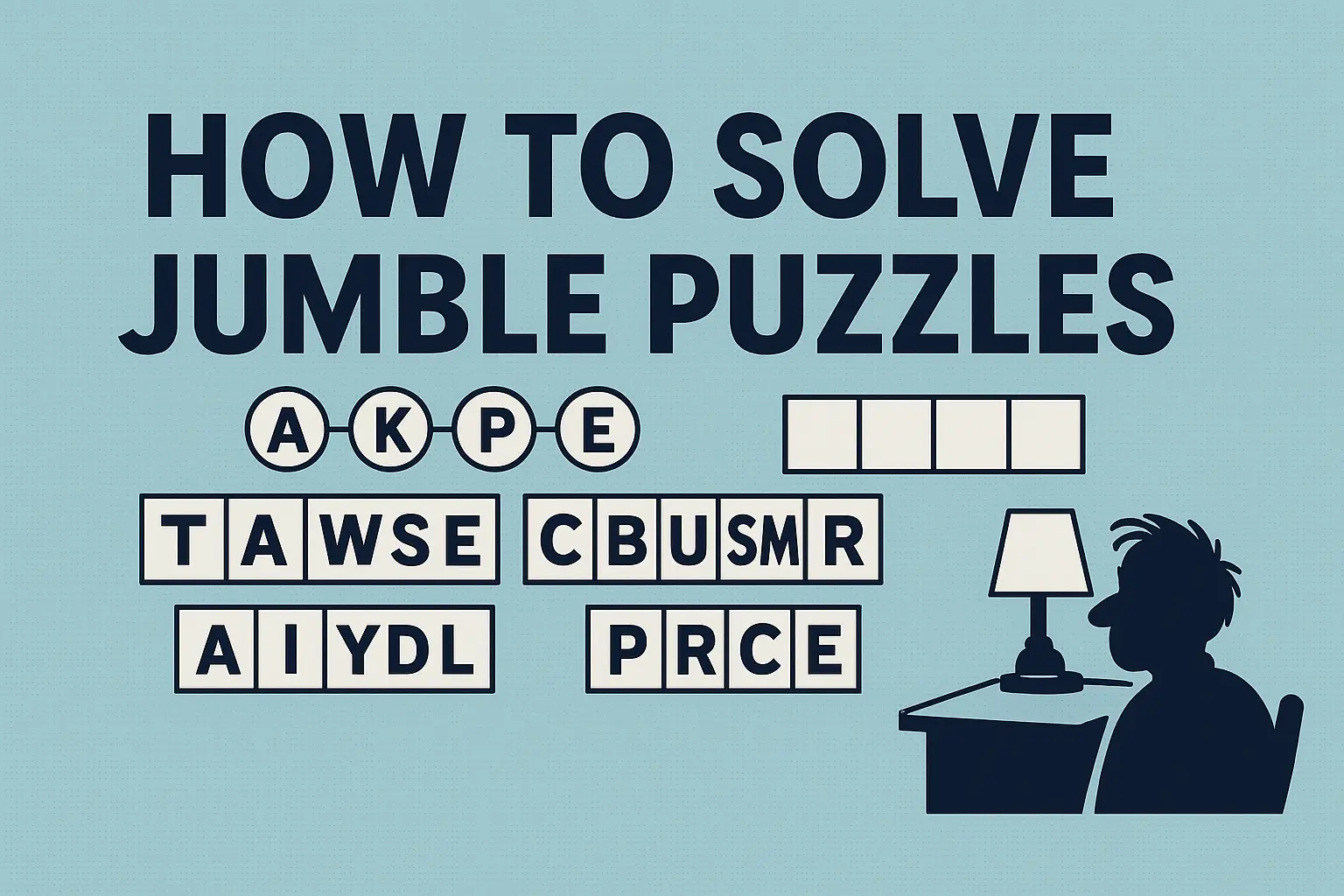
If you love wordplay, brain teasers, or morning newspaper puzzles, you’ve probably come across Jumble puzzles. They are fun, challenging, and surprisingly effective at sharpening your mind.
But if you often get stuck staring at scrambled letters—don’t worry. This guide on How to Solve Jumble Puzzles will turn you into a faster, smarter decoder.
This is an evergreen, step-by-step tutorial designed for both beginners and seasoned solvers.
What Is a Jumble Puzzle?
A Jumble puzzle is a classic word game where a group of letters is scrambled, and your task is to rearrange them into a meaningful English word.
It appears daily in newspapers, magazines, puzzle books, and digital word-game apps. For anyone learning How to Solve Jumble Puzzles, understanding the structure of a Jumble is the first and most important step.
Each daily Jumble typically contains:
- Four scrambled words
- Circled letters inside each solution
- A final cartoon-based riddle solved using those circled letters
This two-stage format is what makes Jumble puzzles different from simple anagrams.
First, you decode each mixed-up word. Then, you use the highlighted letters to uncover the final joke or pun connected to the cartoon. This combination of wordplay and humor is why so many people enjoy Jumbles as part of their daily routine.
Jumble puzzles strengthen your brain by improving vocabulary, pattern recognition, and problem-solving skills.
And as you explore different strategies for How to Solve Jumble Puzzles, you’ll notice that the more you play, the faster your decoding ability becomes.
Benefits of Solving Jumble Puzzles
Solving Jumble Puzzles isn’t just a fun hobby—it’s a powerful brain-boosting activity with long-lasting cognitive benefits.
Whether you’re a beginner learning How to Solve Jumble Puzzles or someone who plays them daily, these puzzles sharpen multiple mental skills while offering a refreshing break from everyday stress.
Here are the most important benefits:
1. Enhances Vocabulary and Word Recognition
Jumble puzzles expose you to new words, uncommon letter patterns, and different spellings.
As you practice How to Solve Jumble Puzzles, your vocabulary naturally expands, and your brain becomes better at identifying word structures and meanings.
2. Boosts Cognitive Speed and Brain Flexibility
Decoding scrambled letters forces your brain to think quickly and switch between different possibilities. This kind of mental flexibility improves:
- Processing speed
- Pattern recognition
- Memory recall
Regular solvers often notice they can solve puzzles—and even everyday problems—more quickly.
3. Strengthens Problem-Solving Skills
Every Jumble is like a mini puzzle that challenges you to think creatively.
As you refine your techniques for How to Solve Jumble Puzzles, you develop stronger logical reasoning and analytical abilities, which translate into other areas of life.
4. Improves Focus and Concentration
Solving Jumbles requires complete attention to detail—spotting vowel placements, identifying letter pairs, or testing new combinations.
This sharpens your ability to concentrate for longer periods, helping your mind stay calm and centered.
5. Reduces Stress and Provides Mental Relaxation
Many people solve Jumbles as part of their morning routine because it’s relaxing yet engaging. The challenge is stimulating without being overwhelming, making it a great way to:
- Reduce anxiety
- Take a mental break
- Enjoy a few peaceful minutes
Learning How to Solve Jumble Puzzles becomes a satisfying, stress-relieving activity rather than a tedious task.
6. Encourages Healthy Daily Habits
Because Jumble puzzles are short and enjoyable, they’re easy to fit into your day. Solving even one puzzle regularly builds a consistent mental exercise routine—just like a crossword or Sudoku.
7. Sharpens Spelling and Letter Arrangement Skills
As you learn How to Solve Jumble Puzzles faster, your spelling naturally improves.
You start recognizing correct letter sequences instinctively, which is especially useful for students, writers, and anyone who works with words.
8. Great for All Ages
Jumble puzzles are simple enough for kids to enjoy and challenging enough for adults to benefit from. They can be used as a fun learning tool or as a daily brain workout to keep the mind sharp.
Whether you’re solving for fun, improving your vocabulary, or training your brain, the benefits of Jumble puzzles are endless.
And as you continue mastering How to Solve Jumble Puzzles, you’ll notice real improvements in mental clarity, creativity, and problem-solving ability.
How to Solve Jumble Puzzles (Step-by-Step)
Learning How to Solve Jumble Puzzles becomes much easier when you follow a clear, structured approach.
While Jumbles may seem tricky at first, decoding them is simply a combination of pattern recognition, logical thinking, and a few smart techniques.
Below is a step-by-step method designed for beginners and puzzle enthusiasts who want to solve Jumbles faster and more confidently.
Step 1: Identify Common Prefixes and Suffixes
One of the quickest ways to start solving a scrambled word is to look for familiar beginnings or endings.
Common prefixes: un-, re-, in-, dis-, pre-, pro-
Common suffixes: -ing, -ed, -er, -tion, -ly
When you’re learning How to Solve Jumble Puzzles, these clues help you instantly eliminate impossible combinations and move toward the correct word structure.
Step 2: Count the Vowels and Consonants
Most English words follow a natural vowel–consonant rhythm. Check how many vowels you have and how they can fit inside the word.
Examples:
- 1 vowel → likely a 3- or 4-letter word
- 2 vowels → balanced 5- or 6-letter word
- Vowel pairs like ea, ou, ai often appear together
This step alone makes solving Jumbles significantly easier.
Step 3: Try the First-Letter Strategy
Choose each consonant one by one and test it as the starting letter. This is one of the most effective ways to learn How to Solve Jumble Puzzles manually.
Example:
Scramble: NTAO
Try:
- N + TAO
- A + NOT
- O + NAT
- T + NAO
Eventually, you spot ATOM — the correct answer.
Step 4: Break Letters Into Sound Chunks
Sometimes saying the letters out loud helps your brain “hear” the correct combination. Sound-based solving is especially helpful for beginners learning How to Solve Jumble Puzzles without tools.
Example:
LVOE → saying it aloud hints at LOVE.
Step 5: Look for Common Letter Pairs
English words frequently use recognizable letter pairs. Spotting these instantly boosts your solving speed.
Common pairs include:
- TH
- CH
- SH
- ST
- TR
- OO
- EA
- QU
When you place these combinations together, the rest of the word often falls into place.
Step 6: Rearrange the Word Length Wisely
The length of the scrambled word gives you strong clues:
- 4-letter words often have one vowel in the middle
- 5-letter and 6-letter words follow more structured vowel placement
- Longer words are easier once you identify the root word (ex: play → player, playful, replay)
Understanding this pattern is a key part of mastering How to Solve Jumble Puzzles quickly.
Step 7: Write or Rewrite the Letters Physically
Your brain processes letters differently when you see them arranged in a new order. Writing them on paper or typing them into a separate area helps you visualize better combinations.
Step 8: Use the Cartoon Clue for the Final Answer
In daily newspaper Jumbles, the final solution is based on:
- The cartoon
- The joke
- The theme of the drawing
After solving the individual words, use the circled letters to complete the pun-based final answer. This is where creativity meets logic — the essence of How to Solve Jumble Puzzles.
Step 9: Practice Regularly for Faster Results
The more puzzles you solve, the faster your brain recognizes patterns. Just 5 minutes a day can dramatically improve your:
- Word recall
- Spelling accuracy
- Pattern recognition
- Overall solving time
Practice is the secret behind every expert who knows How to Solve Jumble Puzzles effortlessly.
Solving Jumbles isn’t about luck — it’s about understanding word patterns, training your brain, and applying the right techniques consistently.
With these step-by-step strategies, you’ll be able to approach even the toughest scrambled words with confidence.
Proven Techniques to Decode Words Faster
Once you understand the basics of How to Solve Jumble Puzzles, the next step is to master proven techniques that help you decode scrambled words in seconds.
These strategies are used by experienced solvers to quickly break down complex letter combinations, spot hidden patterns, and find the correct answer with minimal effort.
Below are the most effective techniques to help you decode words faster and improve your puzzle-solving skills.
1. The Reverse Reading Trick
One of the smartest techniques is reading the scrambled letters backwards. Seeing the letters from a different angle helps your brain form new patterns and break out of familiar thinking.
Example:
Scramble: RAEL
Forward: rael → not obvious
Backward: lear → REAL becomes obvious
This trick works especially well for beginners still learning How to Solve Jumble Puzzles.
2. The Vowel Anchor Method
Vowels act as the “anchors” of most English words. Place the vowels in the center and try building consonants around them.
Example:
Scramble: MTOI
Vowels: O, I
Possible centers: _ O _ I or _ I _ O
Result: OMIT
This technique allows you to decode even tricky jumbles quickly.
3. Identify Common Letter Pairs
English relies heavily on recurring letter combinations. Spot these instantly and the rest of the word often reveals itself.
Common pairs include:
- TH (think, that, this)
- CH (chair, cheese)
- SH (shop, shape)
- ST (step, stop)
- TR (tree, train)
- QU (queen, quick)
- OO, EE, EA
Recognizing these clusters significantly improves your speed when practicing How to Solve Jumble Puzzles.
4. Sound It Out (Phonetic Method)
Say the letters out loud or gently rearrange them while sounding them. Your ears often catch combinations your eyes miss.
Example:
Scramble: HETR
Saying it out loud → “ther” → THER → HER T → THER → THER → R E T H → eventually your mind hears “HER T” → “THE R” → “THE R” → “THRE” → “THERE”
This technique is surprisingly effective for short and medium-length words.
5. Use the Consonant Swap Strategy
Swap the first two consonants and see if a recognizable word appears. This is helpful when you know the letters belong to a common word family.
Example:
Scramble: LPHAE
Swapping consonants and inserting vowels → ALPHA
This small but powerful trick can instantly unlock many daily Jumble words.
6. Break the Word Into Smaller Chunks
Divide the letters into two or three logical parts.
Example:
Scramble: NIGTH
Break: NIG + TH → rearrange → THING
Chunking helps your brain process smaller units instead of one confusing block.
7. Look for the Root Word
Many scrambled words are based on simple root words with endings like:
- ed
- ing
- er
- ly
Example:
Scramble: INGTAR
Root word → STAR / TRAIN → rearrange → RATING
This is a core technique in mastering How to Solve Jumble Puzzles efficiently.
8. Try Eliminating Impossible Combinations
Some letter placements simply don’t appear in English words.
For example:
- No English word starts with NG
- Q is almost always followed by U
- Words rarely end with J or V
By removing impossible patterns, you reduce the number of valid combinations.
9. Use Letter Frequency Logic
Some letters appear far more often in English words.
Common letters: E, T, A, O, I, N
Rare letters: Z, Q, X, J
If you see a common letter in your scramble, try placing it in key positions (start or middle) to see if a word forms.
10. Practice the “Visualization Shuffle”
Write the letters, then rewrite them in a new order. Even a small change helps your brain view the scramble differently.
This is especially useful when solving the daily cartoon Jumble and trying to uncover the final pun.
Why These Techniques Work
All these techniques are rooted in:
- Pattern recognition
- Word probability
- Phonetic awareness
- English letter behavior
When combined, they dramatically speed up your ability to decode words and make learning How to Solve Jumble Puzzles more enjoyable and efficient.
Common Letter Patterns to Remember
One of the most effective ways to master How to Solve Jumble Puzzles quickly is to recognize common letter patterns used in everyday English words.
These patterns act like shortcuts—once you learn them, your brain begins to automatically spot familiar shapes, pairings, and structures inside scrambled letters. This dramatically reduces solving time and improves accuracy.
Below are the most important letter patterns to remember while decoding Jumbles.
1. Popular Prefixes
Prefixes commonly appear at the beginning of scrambled words. Learning them helps you instantly eliminate wrong combinations.
Common prefixes include:
- re- (redo, return, refund)
- un- (undo, unlock, unfair)
- in- / im- (insure, imply, input)
- dis- (disconnect, discover)
- pre- (prepare, preview)
- pro- (proceed, promote)
Spotting these right away is a core skill in improving your speed when practicing How to Solve Jumble Puzzles.
2. Common Suffixes
Suffixes appear at the end of many solutions, especially in 5–8 letter Jumbles.
Frequently used suffixes:
- -ing
- -ed
- -er
- -est
- -tion
- -ly
- -ful
- -ment
When a scrambled word has repeated letters or multiple vowels, a suffix is often part of the solution.
3. High-Frequency Letter Pairs
English uses certain letter pairs repeatedly. Identifying these pairings helps your brain assemble words more efficiently.
Most common pairs:
- TH
- CH
- SH
- PH
- ST
- TR
- QU
- OO
- EE
- EA
Example:
Scramble: TOSRH
Spot TH → rearrange → SHORT
This is a powerful trick in learning How to Solve Jumble Puzzles quickly.
4. Vowel Pairings
Certain vowels often appear together in English words. If your jumble has two or more vowels, try pairing them first.
Common vowel combinations:
- AI (rain, paint)
- EA (reach, teach)
- OU (sound, round)
- IE (piece, chief)
- OO (room, food)
These clusters often give away the middle of the word.
5. Silent Letter Patterns
Silent letters appear frequently in English, and recognizing them can instantly clarify tricky Jumbles.
Common silent letter combinations:
- KN (knee, know)
- GN (sign, align)
- WR (write, wrong)
- MB (comb, thumb)
If your scrambled letters include K + N or W + R, try placing them together.
6. Common Word Endings in Jumble Solutions
Many Jumble answers tend to use predictable endings.
Examples:
- -IGHT (light, night, sight)
- -ATCH (catch, match)
- -ABLE (table, stable)
- -ANCE (dance, chance)
Patterns like these help you see the “shape” of the word before solving it.
7. Repeated Letters That Form Patterns
Repeated letters often indicate double-letter patterns:
- LL (spell, chill)
- SS (press, glass)
- TT (letter, butter)
- EE (free, see)
- OO (soon, book)
If your jumble contains two of the same letter, try placing them together first.
Why Letter Patterns Matter
Letter patterns provide structure. They help narrow possibilities instantly and transform a random jumble of letters into a meaningful sequence.
As you practice How to Solve Jumble Puzzles, you’ll start noticing these patterns automatically—making each puzzle easier than the last.
Tools & Strategies to Improve Your Jumble Skills
Mastering How to Solve Jumble Puzzles becomes much easier when you combine smart strategies with the right tools.
Whether you’re a casual solver or someone who completes the daily Jumble religiously, these tools and methods will help sharpen your speed, accuracy, and overall puzzle-solving ability.
Below are the best tools and proven strategies to elevate your Jumble game.
1. Use Word Unscrambler Tools
A word unscrambler is one of the most effective tools for practicing How to Solve Jumble Puzzles, especially for beginners.
Popular tools include:
- UnscrambleX
- WordFinder
- WordTips Jumble Solver
- YourDictionary’s Word Unscrambler
- Scrabble Word Helper
These tools take scrambled letters, analyze thousands of English words, and generate meaningful possibilities instantly. While you shouldn’t rely on them entirely, they are excellent for:
- Building vocabulary
- Understanding word patterns
- Learning new letter combinations
2. Practice Daily on Word Games & Apps
Apps designed for word puzzles are a fantastic way to reinforce your Jumble skills.
Recommended apps:
- Wordscapes
- Microsoft Ultimate Word Games (includes Jumble-like challenges)
- Word Breaker
- Jumble Crossword
- Word Collect
These apps strengthen the same skills needed for mastering How to Solve Jumble Puzzles, including pattern recognition, letter placement, and quick decoding.
3. Write Letters Down in Different Orders
Rewriting the letters is one of the simplest yet most effective strategies.
When stuck:
- Rewrite the letters in a new order
- Group vowels together
- Move consonants around
- Try forming pairs like “th,” “st,” “ch,” or “qu”
This change of visual layout helps your brain break out of a fixed pattern and discover the correct combination.
4. Use Flashcards to Memorize Common Patterns
Flashcards help train your brain to instantly recognize:
- Prefixes
- Suffixes
- Vowel combinations
- High-frequency letter pairs
With consistent practice, these patterns become automatic, making How to Solve Jumble Puzzles much faster.
5. Build a “Word Bank” of Common Jumble Answers
Create a small notebook or digital list containing:
- Frequently used 4-letter words
- Common 5-letter scrambled words
- Typical Jumble endings (-ing, -tion, -able, etc.)
You’ll be surprised how often similar patterns repeat in daily Jumbles.
6. Set a Timer to Increase Speed
If you want to boost your solving speed:
- Set a 30-second or 1-minute timer per word
- Practice solving without overthinking
- Track your progress weekly
Timed drills are especially effective for anyone serious about improving How to Solve Jumble Puzzles competitively or consistently.
7. Improve Vocabulary Through Reading
Reading books, newspapers, blogs, and articles exposes you to a wide range of words—many of which appear in Jumble puzzles. Strong vocabulary = faster decoding.
Focus on:
- Fiction novels
- Editorial columns
- Word-of-the-day apps
The more words you know, the easier Jumbles become.
8. Solve Older Jumble Puzzle Archives
Most Jumble websites and newspapers keep archives of old puzzles. Practicing these is like training your brain at the gym.
Older puzzles help you:
- Identify recurring themes
- Recognize favorite words
- Understand typical puzzle structure
You’ll naturally get better at How to Solve Jumble Puzzles with repeated exposure.
9. Use the “Elimination Method”
Remove letters that don’t logically fit:
- Words rarely begin with “ng,” “jl,” or “xr”
- “Q” almost always pairs with “U”
- Double vowels often appear in the middle
The elimination method cuts down the number of possible combinations instantly.
10. Stay Consistent—Solve One Jumble Every Day
Consistency is the secret to mastering anything.
Solving even one Jumble puzzle daily will:
- Sharpen your brain
- Improve recall
- Strengthen mental agility
- Build long-term decoding skills
Just 5 minutes a day can dramatically improve your ability to solve any word scramble.
Combining smart tools with daily practice is the fastest way to become truly skilled at How to Solve Jumble Puzzles.
With these tools and strategies, you’ll decode words faster, recognize patterns more clearly, and enjoy solving Jumbles more than ever.
FAQs
Q1. What is the easiest way to start solving Jumbles?
Start by identifying familiar prefixes, suffixes, and letter pairs.
Q2. How long does it take to get faster?
With daily practice, most people improve noticeably within 7–14 days.
Q3. Can Jumble puzzles improve vocabulary?
Absolutely. They expose you to unusual word combinations and spelling variations.
Q4. What if I get stuck on a word?
Rewrite the letters, say them out loud, or try pairing consonants differently.
Q5. How do I solve the final cartoon answer in a daily Jumble?
First, solve each scrambled word and collect the circled letters. Then use those letters—along with the cartoon clue—to form a witty, pun-based final answer. The cartoon usually hints at the theme.
Q6. How can I get faster at Jumbles?
Consistency is key. Solving at least one Jumble puzzle per day improves your speed naturally. Using techniques like pattern recognition, letter grouping, and timed practice will also make you faster.
Q7. Do Jumbles repeat words or patterns?
Yes, many daily Jumbles reuse common letter patterns, word structures, and endings like -ING, -ION, or -ER. Recognizing these makes solving easier, especially as you master How to Solve Jumble Puzzles.
Final Thoughts
Mastering How to Solve Jumble Puzzles is a skill that grows stronger with practice, patience, and the right techniques.
Jumbles may look simple on the surface, but they sharpen your mind in powerful ways—boosting vocabulary, improving pattern recognition, and strengthening your problem-solving abilities.
As you continue using the strategies, tools, and letter patterns covered in this guide, you’ll notice that scrambled words begin to feel less intimidating and more like fun challenges you can decode with confidence.
Whether you’re solving the daily newspaper Jumble, playing word games on your phone, or just trying to improve your mental agility, Jumble puzzles offer endless opportunities to learn and grow.
The key is consistency: the more you practice, the faster and more intuitive your solving process becomes.
With the steps and techniques outlined in this guide, you’re now equipped with everything you need to solve even the trickiest letter scrambles. .
So keep practicing, stay curious, and enjoy the rewarding process of becoming faster and better at How to Solve Jumble Puzzles—one word at a time.