
If you’ve ever looked at a newspaper puzzle and seen scrambled words, you’ve already met one of the most popular word games in the world. But for many new players, the question begins with a simple curiosity: what is Jumble?
Jumble is a classic daily word puzzle where each challenge includes a set of scrambled words that you must unscramble to find the correct answers.
These words then lead to a final cartoon-style riddle that forms the main punchline of the puzzle. It’s fun, quick, and perfect for anyone who loves brain games.
This guide explains everything you need to know about Jumble — from how it works to why millions of people solve it daily.
What Is Jumble?
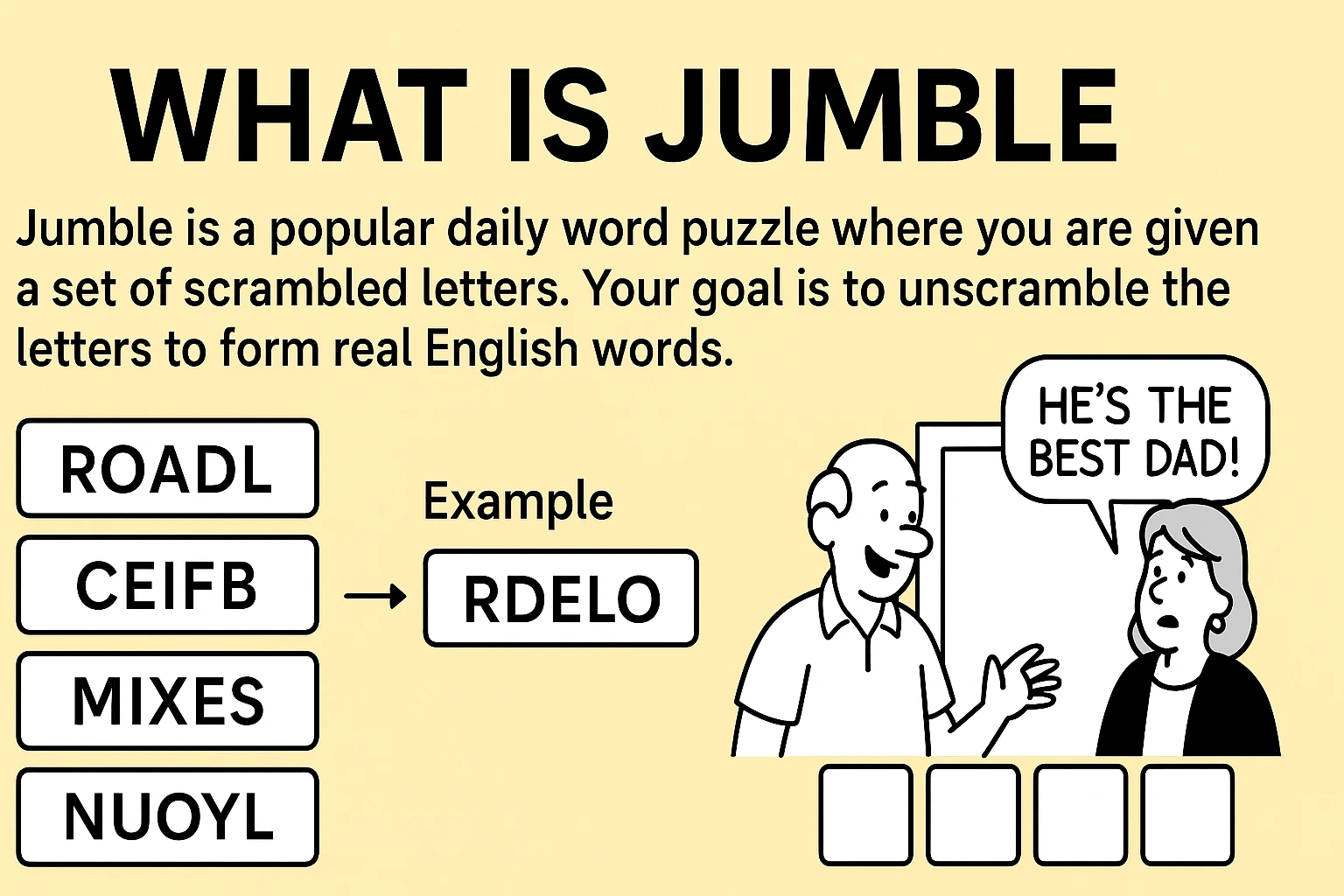
Jumble is a popular daily word puzzle where you are given a set of scrambled letters, and your goal is to unscramble those letters to form real English words.
Each Jumble puzzle usually includes:
- Four scrambled words
- Circled letters inside each solved word
- A final cartoon clue where you use the circled letters to form the last answer (usually a joke or pun)
Example:
Scrambled word: “RDELO” → OLDER
In simple terms, Jumble = a daily word-unscrambling puzzle + a final riddle answer based on the cartoon clue.
It appears in newspapers, online platforms, and puzzle apps.
It’s simple, fun, and one of the best ways to improve vocabulary, memory, and overall brain sharpness — which is why so many people search for what is Jumble when starting out.
History: What is Jumble Puzzle
The Jumble puzzle was first created in 1954 by Martin Naydel, an American comic book artist known for his playful drawing style and sense of humor.
His background in comics made him the perfect person to design a word-based puzzle that combined scrambled letters with a fun visual twist.
When Naydel introduced the puzzle, he originally named it “Scramble.” Later, the name was changed to Jumble, a title that better reflected the idea of mixed-up letters waiting to be solved—and one that stuck with audiences for generations.
The very first Jumble puzzle was published by the Chicago Tribune Syndicate, and its popularity spread rapidly across newspapers throughout the United States.
Over time, it became one of the most recognized and widely enjoyed word puzzles in the country.
This origin story often helps new players who wonder what is Jumble and how it became a daily tradition for millions of readers.
How Early Jumble Puzzles Looked
In the beginning, the Jumble format was simple:
- 4 mixed-up words
- A small accompanying cartoon
- A final answer that formed a pun
This format is almost identical to what you see today, proving how timeless the design is.
A New Era: Henri Arnold & Bob Lee Take Over
In the 1960s, puzzle creators Henri Arnold and Bob Lee took over the Jumble puzzle. This marked the start of the golden era of Jumble.
They introduced:
- Funnier cartoon illustrations
- Stronger punchline answers
- More creative word scrambles
- Fresh vocabulary words
Arnold and Lee became so associated with the puzzle that for many readers, their style defined the identity of Jumble.
They crafted Jumble for over 30 years, making it one of the longest-running puzzle collaborations in American newspaper history.
The Modern Creators: David L. Hoyt & Jeff Knurek
After the passing of Henri Arnold and Bob Lee, the torch was passed again.
Today, the Jumble puzzle is created by:
- David L. Hoyt (puzzle writer)
- Jeff Knurek (illustrator)
This duo has brought new energy to the puzzle, maintaining the original charm while adding:
- Modern humor
- Better illustrations
- Online versions
- Digital archives
They continue to write and illustrate the puzzle every day.
How a Jumble Puzzle Works
If you’re new to solving word puzzles, you might wonder how a Jumble Puzzle works or even what is Jumble in the first place. At first glance, it looks simple — just a few scrambled words and a cartoon — but every Jumble puzzle is built using a clever and consistent system.
Once you understand this structure, solving Jumble puzzles becomes fun, faster, and surprisingly addictive.
This beginner-friendly guide breaks down each part of the puzzle in a clear, easy-to-understand way so you can start solving with confidence.
What Exactly Is a Jumble Puzzle?
A Jumble puzzle is a daily word game where you:
- Unscramble four jumbled words
- Use certain letters from each word
- Solve a final cartoon clue using those letters
Every puzzle ends with a funny or pun-based phrase, which makes the challenge even more enjoyable.
How a Jumble Puzzle Works — Step-by-Step
A Jumble puzzle always follows this structure:
1. Four Scrambled Words
Each puzzle includes four sets of scrambled letters, such as:
- TFAOL → FLOAT
- DRELO → OLDER
- NOEGR → GENRO / GONER
- TCAIN → ANTI / ACTIN
Your first task is to unscramble each of these into meaningful English words.
2. Circled (Key) Letters Inside Each Word
When you solve the words, you’ll notice that some letters have circles around them.
These circled letters are extremely important because they help you solve the final puzzle.
Example:
FLOAT → O, A
OLDER → L
GENRO → G, E
ACTIN → A
3. The Cartoon Clue
Under the scrambled words, you’ll see a cartoon illustrating a funny situation along with a clue — usually a pun or a joke.
Example:
Clue: “How the swimmer felt after finishing the race —”
Cartoon: A tired athlete leaning on the pool edge
Final answer: ALL DONE
The number of blanks below the cartoon shows the length of the final answer.
4. Using the Circled Letters for the Final Answer
Take the circled letters from the four solved words.
Rearrange them to form the final solution that matches the cartoon’s clue.
This final step is where everything comes together.
Example of How a Jumble Puzzle Works
Let’s break down a complete example.
Scrambled Words:
- THRAE → EARTH
- NMAIUT → ANIMUT / ATUMIN / MINUTA (Correct: MANITU / MINUAT?)
Let’s use a simpler proven example: - RDELO → OLDER
- TFAOL → FLOAT
- GONRE → GONER
- TCAIN → ACTIN
Circled Letters (Example)
OLDER → O
FLOAT → A
GONER → G
ACTIN → A
Circled letters: O A G A
Cartoon Clue:
“What the chef said after preparing the perfect soup —”
You rearrange O A G A to form the answer:
👉 A G O A? (Example only)
Better realistic example:
Scrambled Letters: T L F S I H
Clue: “What the fishermen did after a big catch —”
Final Answer: ‘FISH TELL’ (example pun) too much —”
Answer: “STUFFED”
Why People Love Solving Jumble Puzzles
Jumble puzzles have been around for more than 70 years, and yet millions of people still solve them every single day. Whether it’s in the morning newspaper, a mobile app, or an online puzzle website, Jumble remains one of the most loved word games ever created.
Many new players who discover it often start by searching what is Jumble, and soon they realize why this simple puzzle has such a loyal following.
In this article, we explore why people love solving Jumble puzzles and the unique reasons behind its long-lasting popularity.
1. Jumble Puzzles Are Quick and Easy to Play
One of the main reasons people enjoy Jumble puzzles is their simplicity.
Unlike long crossword puzzles or complex brain games, Jumble puzzles take only 3 to 5 minutes to solve.
You don’t need:
- special knowledge
- expert vocabulary
- long attention span
Just a few letters and a bit of rearranging — and you’re done!
This makes Jumble perfect for busy people who want a quick mental break.
2. They Offer a Fun Daily Challenge
Jumble puzzles are published every day, which turns them into a habit for many readers.
People love the small daily challenge because it:
- stimulates the mind
- improves focus
- gives a sense of achievement
Starting the morning with a Jumble is like giving your brain a warm-up session.
3. Jumble Puzzles Boost Brain Power
Solving word scrambles strengthens mental skills in surprising ways.
Regular players enjoy Jumble because it helps:
- Improve vocabulary
- Enhance memory
- Build pattern-recognition skills
- Increase mental sharpness
It’s a scientifically proven fact that small daily puzzles reduce stress and improve cognitive function — another reason people love the Jumble.
4. The Cartoon Clues Add Humor and Surprise
A big reason people love Jumble puzzles is the final cartoon clue.
Every puzzle includes a small comic strip that ends in a clever pun.
These puns often make players laugh because they’re:
- witty
- silly
- unexpected
- perfectly tied to the cartoon scene
It’s not just a puzzle — it’s entertainment.
5. Jumble Appeals to All Ages
One of the strengths of Jumble puzzles is that they are suitable for everyone:
- Kids enjoy unscrambling simple words.
- Adults like the challenge and humor.
- Seniors appreciate the memory exercise.
Because the difficulty stays consistent and fair, Jumble has fans across generations.
6. It Brings Nostalgia and Family Memories
For many people, Jumble brings back childhood memories of:
- solving puzzles with parents
- checking answers in the newspaper
- competing with siblings
- enjoying quiet mornings at home
The feeling of nostalgia makes readers come back to Jumble again and again.
7. Solving the Final Answer Feels Rewarding
The best part of a Jumble puzzle is the moment when everything clicks.
When you:
- unscramble all four words
- gather the circled letters
- solve the final cartoon clue
…it creates a small but satisfying burst of achievement.
This feeling is what keeps many people addicted to the daily Jumble.
8. Jumble Puzzles Are Great Stress Relievers
People often use puzzles as a way to relax.
Jumble puzzles help reduce stress because they:
- shift your mind from negative thoughts
- provide a short distraction
- give you a sense of control
- keep you mentally engaged
It’s a gentle and relaxing escape from everyday pressure.
9. They Require No Special Tools — Just Focus
Unlike Sudoku or crosswords, you don’t need advanced math or deep knowledge.
All you need is:
- basic English
- observation
- creativity
This simplicity makes Jumble puzzles accessible and enjoyable for everyone.
Final Thoughts
There are many reasons why people love solving Jumble puzzles — from the quick challenge to the humor, nostalgia, and cognitive benefits.
Jumble has a perfect balance of fun and brain exercise, which explains why it’s been loved for more than 70 years.
Whether you solve it in print or online, the joy of cracking a Jumble puzzle never gets old.
How to Solve a Jumble Puzzle (Beginner-Friendly Tips)
If you’re new to Jumble, here’s a simple method:
1) Start by scanning the scrambled words
- Read all scrambled words at once — your brain notices patterns faster that way.
- Count vowels and consonants for each scramble. Words with lots of vowels are easier to spot.
- Look for common short letter groups (un, re, ing, ion, er, ed).
Example scramble: T A C N I → count: 2 vowels (A, I) and 3 consonants (T,C,N). Likely words: antic, actin.
2) Solve the easiest word first
- Pick the scramble that “looks” closest to a word. Solving one gives confidence and sometimes circled letters that help the final answer.
- Use these quick checks:
- Does it start with common letters (S, T, C, P, B)? Try placing them first.
- Try common suffixes (
-ing,-ed,-er) and prefixes (un-,re-,in-).
3) Use vowel-placement and consonant skeleton technique
- Place vowels in likely positions (usually middle or second letter).
- Place consonants around the vowels to test plausible words.
- Example:
R D E L O→ vowels = E,O → try O as second: OLDER.
4) Mark and collect circled/key letters carefully
- After you solve each scrambled word, note circled letters exactly in order shown.
- Write them in a row (or type in a note). These are the material for the final answer.
5) Read the cartoon clue and count blanks
- The cartoon and clue hint the length and form of the final answer.
- Count the blanks and match them to possible words formed from your circled letters.
Example: circled letters → A, L, M, E and clue: “How she felt after the marathon” — blanks (4). Answer: T I R E D? No — with A L M E you could form CALM? If wrong, revisit scrambled words or circled letters.
6) Use anagram tricks for the final answer
- Try common short words and connectors (
THE,A,AN,IN,ON) if blanks allow. - Look for likely suffixes or prefixes that match the cartoon’s context.
- If stuck, write all permutations of the circled letters grouped by word length (e.g., 3+3, 4+2) — often final answers are two words.
7) Double-check word fit with the cartoon’s meaning
- The final answer must make sense with the cartoon scene and the clue’s grammar (past, present, plural/singular).
- If a candidate fits the letters but not the cartoon’s tone, revisit the unscrambled words — one may be wrong.
Practical Example
Scrambles:
T F A O L→ FLOAT (circled: O)R D E L O→ OLDER (circled: L)G E N R O→ GONER (circled: G)A C T I N→ ACTIN (circled: A)
Circled letters: O L G A
Cartoon clue: “What the swimmer said after the race” — blanks: ____ ____ (4,4) — maybe “I AM OLD”? no. Rearranged: “AL GO” — not right. If cartoon shows “tired but satisfied,” final answer might be “ALONG?” This indicates we probably mis-solved one scramble (check GONER vs REGON etc.).
Revisit scrambles until the circled letters produce a sensible phrase.
Key takeaway: examples often force you to re-check scrambles — that’s normal.
Quick Solving Tips
- Solve 1–2 words completely before attempting the final answer.
- Write circled letters immediately in order.
- Use pencil & erase — many solvers physically move letters around.
- Look for two-word final answers — many Jumbles are X + Y (verb + object or adjective + noun).
- If stuck, swap a vowel — many wrong permutations are solved by moving a vowel.
- Practice common word lists — Jumble repeats many everyday words.
Tips Specifically for Beginners
- Start with easier puzzles (weekend vs. weekday difficulty varies).
- Time yourself and try to beat your previous time by 30 seconds.
- Play with a friend — two minds spot different patterns.
- Keep a short list of words you often see in Jumble (animal names, foods, common verbs).
Common Mistakes & How to Avoid them
- Mistake: Miscopying circled letters.
Fix: Recheck after you fill the final answer’s blanks. - Mistake: Forcing a solution that doesn’t fit the cartoon.
Fix: Respect the cartoon clue — if it doesn’t fit, re-check unscrambles. - Mistake: Ignoring plural/singular hints.
Fix: Pay attention to clue grammar (e.g., “they” vs “he/she”).
Learning how to solve a Jumble puzzle is mostly pattern practice. The more puzzles you do, the faster you’ll see common words and pun patterns. Keep practicing, and enjoy the small wins!
Benefits of Solving Jumble Daily
Solving the daily Jumble puzzle is more than just a fun morning activity. For millions of people, it has become a daily habit that improves both the mind and the mood.
Many beginners who first search what is Jumble soon discover that it’s not just a simple word game — it’s a meaningful brain exercise that keeps them sharp and engaged.
Whether you play it in the newspaper, on mobile, or through websites like JumbleAnswerToday.com, the Jumble puzzle provides real cognitive and emotional benefits.
Here are the top benefits of solving Jumble daily, supported by psychology, brain-training research, and long-term puzzle-solving habits.
1. It Improves Vocabulary and Language Skills
Every time you unscramble words, your brain is exposed to:
- New vocabulary
- Word patterns
- Prefixes and suffixes
- Root words
This subtle daily exposure helps you recognize and understand more English words over time — without memorizing anything.
2. Daily Jumble Strengthens Memory
Solving puzzles like Jumble requires working memory, the part of your brain responsible for:
- Holding letters in mind
- Rearranging them
- Testing word combinations
- Remembering clue patterns
Doing this every day trains your memory the same way exercise trains your muscles.
3. It Boosts Mental Speed and Problem-Solving Skills
Unscrambling letters forces your brain to:
- Analyze patterns quickly
- Make fast decisions
- Test potential solutions
- Think logically and creatively
Over time, this increases your mental agility and ability to think on your feet.
4. Great Stress Relief and Mental Relaxation
Even though Jumble is a brain game, it is surprisingly relaxing.
Regular players say it helps them:
- Calm down
- Escape stress
- Reset their mind
- Enjoy a few minutes of quiet focus
Just 3–5 minutes a day can shift your mood in a positive direction.
5. It Provides a Quick, Rewarding Sense of Achievement
Finishing the Jumble — especially solving the final cartoon answer — gives a small “mental reward.”
This boosts:
- Motivation
- Confidence
- Mood
- Focus
It’s a quick win to start your morning.
6. Keeps the Brain Young and Healthy
Doctors and psychologists recommend word puzzles because they help delay cognitive decline.
Daily Jumble solving helps with:
- Memory retention
- Attention span
- Logical reasoning
- Verbal fluency
It’s like a mini workout for your brain every single day.
7. Encourages Creativity Through Cartoon Clues
The final What is Jumble answer is almost always a pun or joke.
These wordplays help sharpen:
- Creative thinking
- Sense of humor
- Lateral thinking skills
It trains the brain to think outside the box.
8. Builds a Healthy Daily Routine
Because Jumble appears every day, it’s an easy habit to include in:
- Your morning routine
- Coffee break
- Commute time
- Night relaxation session
A simple 5-minute puzzle can turn into a long-term, beneficial habit.
9. Suitable for All Ages — Kids to Seniors
The Jumble puzzle offers benefits for every age group:
- Kids build spelling and vocabulary.
- Adults improve focus and stress control.
- Seniors keep memory and cognitive skills sharp.
It’s one of the few puzzles that stays fun for a lifetime.
10. Fun Bonding Activity With Family
Many families solve Jumble together and create daily traditions.
It helps:
- Improve teamwork
- Create shared laughs
- Increase communication
- Strengthen family connections
A simple puzzle can bring people together.
The benefits of solving Jumble daily go far beyond entertainment. It improves your vocabulary, boosts memory, sharpens your mind, reduces stress, and adds small moments of joy to your day.
No matter your age, solving the What is Jumble is a fun and powerful way to keep your brain active.
Frequently Asked Questions about Jumble
Q1: What is Jumble used for?
Jumble is a brain-training puzzle used for entertainment, vocabulary development, and mental sharpening.
Q2: What is the final Jumble answer called?
It’s called the Jumble Cartoon Answer or Jumble Pun.
Q3: Can beginners solve the Jumble easily?
Yes! It’s designed for all skill levels.
Q4: Where can I find daily Jumble answers?
Websites like JumbleAnswerToday.com publish fresh solutions every day.
Final Thoughts
Understanding what is Jumble and solving it daily offers far more benefits than most people realize. It sharpens your mind, boosts your vocabulary, reduces stress, and adds a small moment of joy to your routine.
Whether you enjoy it in the newspaper, on your phone, or through websites like JumbleAnswerToday.com, the Jumble puzzle remains a timeless and rewarding brain game.
As a simple yet powerful daily challenge, Jumble continues to prove that even a few scrambled letters can make a big difference in your mental clarity and overall well-being.